Ever since Alfredo Binda won the first UCI Road World Championships in 1927, cycling’s blue riband one-day event has decided the destination of one of the sport’s most prestigious prizes – the rainbow jersey.
These ten promotional posters from 1938 to 1988 offer a 50-year journey through the World Championships, conjuring up stories of triumphs sought and rivalries fought, as well as giving a glimpse into the design flair of the time.
Related: Worlds 1927 – Alfredo Binda, Nürburgring and the first rainbow jersey
1938 – Valkenburg, Netherlands
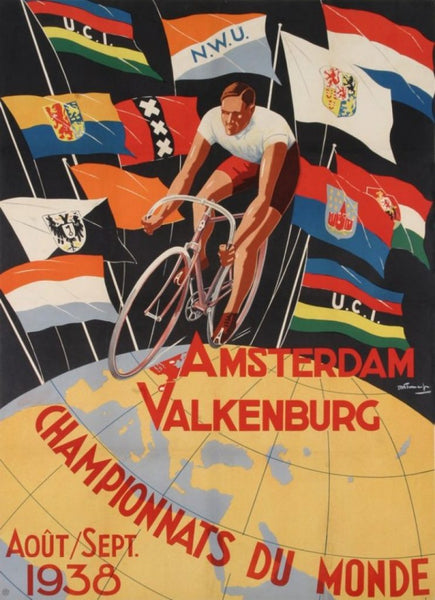
The 1938 UCI Road World Championships was the final event to be held before a seven-year break due to World War Two. Belgium’s Marcel Kint rode to victory having claimed three stages of the Tour de France that summer, in a season that also included podium finishes at the Tour of Flanders and Liège–Bastogne–Liège. Valkenburg, incidentally, has now hosted the worlds five times; only Copenhagen has hosted more (six).
1946 – Zürich, Switzerland

Hans Knecht won the amateur race (equivalent to today’s under-23 race) in 1938 and when the World Championships returned in 1946, the Swiss rider secured the biggest victory of his career by claiming the rainbow jersey in his home country. The outbreak of World War Two had done little to affect Kint’s power, with the Belgian finishing second behind Knecht on his delayed title defence.
1957 – Waregem, Belgium

Classics specialist Rik Van Steenbergen won the World Championships three times during his career, with the Belgian’s final victory coming in his home country. Van Steenbergen, a two-time winner of the Tour of Flanders, Paris-Roubaix and La Flèche Wallonne, outsprinted 1954 champion Louison Bobet and André Darrigade, who would pull on the rainbow jersey in 1959, in Waregem.
1962 – Salò, Italy

The artwork for the 1962 World Championships took on an element of the abstract but there was nothing unusual about Jean Stablinski’s victory in Salò. The Frenchman won 105 times as a professional, with stage wins in all three Grand Tours and an overall victory in the Vuelta a España.
However, Stablinski made an impact on cycling far beyond his time. He had been a coal pit miner in Arenberg before becoming a professional cyclist and when Paris-Roubaix organisers went in search of new cobbled secteurs, the local man stepped in to point race organisers towards the infamous Trouée d’Arenberg, which was added to the Hell of the North in 1968. A memorial to Stablinski now stands at the entrance to Arenberg.
1968 – Imola, Italy

If Copenhagen has hosted the World Championships more than any other city, Italy is the most frequent host country having held cycling’s premier one-day event on 13 occasions.
Imola 1968 saw home rider Vittorio Adorni, winner of the 1965 Giro d’Italia, attack his breakaway companions with 93km remaining on the city’s famous motorsport circuit (longtime home to the Grand Prix of nearby principality San Marino) and solo to victory by nearly nine minutes and 50 seconds – the biggest winning margin in worlds history.
The Italian team strangled the chasing peloton with the help of Adorni’s Faema team-mate, Eddy Merckx, whom he had supported en-route to his first Grand Tour title at the Giro d’Italia earlier that year.
1973 – Barcelona, Spain

Felice Gimondi was among Adorni’s team-mates in 1968 and 'The Phoenix' won a rainbow jersey of his own five years later, having finished third in 1970 and second in 1971. Gimondi’s career coincided with that of Merckx and, despite the former’s five Grand Tour victories, The Cannibal frequently got the better of his rival.
The tables turned in Barcelona, however, with Gimondi outsprinting Belgian duo Freddy Maertens and Merckx in a four-up gallop, with Spain’s Luis Ocaña sandwiched between in third. After the race, Merckx accused Belgian team-mate Maertens of betrayal, while Maertens in turn claimed Merckx had sold the race to Gimondi. The ill-feeling between the pair would last for decades.
1974 – Montreal, Canada

Merckx’s defeat in Barcelona was one of the most unexpected of his career, but the Belgian would win the World Championship title for a third time a year later, equalling the record then held by Alfredo Binda and Rik Van Steenbergen.
Victory in Montreal came in a two-up sprint against Frenchman Raymond Poulidor and capped a golden year in which Merckx became the first rider to win the Triple Crown, having already claimed the Giro d’Italia and Tour de France.
1979 – Valkenburg, Netherlands

The palmares of Jan Raas already included four stages of the Tour de France, three victories in the Amstel Gold Race and a Monument Classics triumph at Milan-San Remo ahead of the 1979 season. However, the biggest wins of the Dutchman’s career came that year, when Raas won the Tour of Flanders and the UCI Road World Championships on home soil.
Raas’ victory in Valkenburg saw him outsprint West Germany’s Dietrich Thurau and France’s Jean-René Bernaudeau, but came amid allegations of being pushed uphill by team-mates on Limburg’s sharp climbs.
1982 – Goodwood, Great Britain

The World Championships returned to Great Britain in 1982, having previously taken place in 1922 (Liverpool) and 1970 (Leicester), this time finishing on the Goodwood motor racing circuit in West Sussex. Italy’s Giuseppe Saronni, who took the silver medal a year earlier, outsprinted Greg LeMond and Sean Kelly with such conviction that it earned him the nickname La Fucilata di Goodwood (The Gunshot of Goodwood).
Mandy Jones won the women’s race, becoming the second British woman to be crowned world champion after Beryl Burton won the title in 1960 and 1967.
1988 – Ronse, Belgium
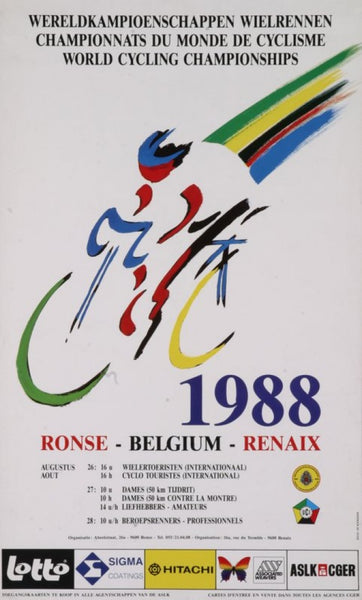
Maurizio Fondriest left Ronse with the rainbow jersey on his back in 1988 after a thrilling finale, not without controversy.
Canada’s Steve Bauer, the 1984 bronze medallist in a race won by Belgium’s Claude Criquielion, bridged across to Fondriest and Criquielion with only a kilometre remaining. Bauer then led out the sprint and changed gear as Criquielion looked to pass on the inside, with Bauer then appearing to nudge his rival with his elbow.
Criquielion, racing just a few miles from his home town, was sent crashing to the ground, while Fondriest rounded Bauer to win and boos rang out from the partisan Belgian crowd. Bauer was disqualified and Criquielion walked across the line in 11th, dragging his damaged bike in one hand and raising his other in protest.
Criquielion would go on to sue Bauer for assault, although the case was thrown out by court after a saga running for more than three years. Criquielion’s career also included victory at the Tour of Flanders but defeat in Ronse would become the Belgian’s most enduring result.
The history of the World Championships is based on an exhibit at the world's best cycling show Rouleur Live. Buy your tickets here