When we mount our bikes, three contact points connect us to our machine: the saddle, the handlebars and the pedals. That's why dialling in your position at these three points is paramount to feeling stronger on the bicycle, avoiding injuries and enjoying riding even more.
Key to this rider-and-machine harmony is cleat position. It’s the only connection between you and your pedals so it makes sense. Which makes it rather nonsensical that far too many of us simply buy cleats and randomly attach them to our shoes.
Know your feet
“Before considering any kind of cleat position, it’s essential to understand the foot’s anatomy: length and width, arch profile and natural angulations like supination or pronation,” explains Tim Allen of Soigneur bike fitting.
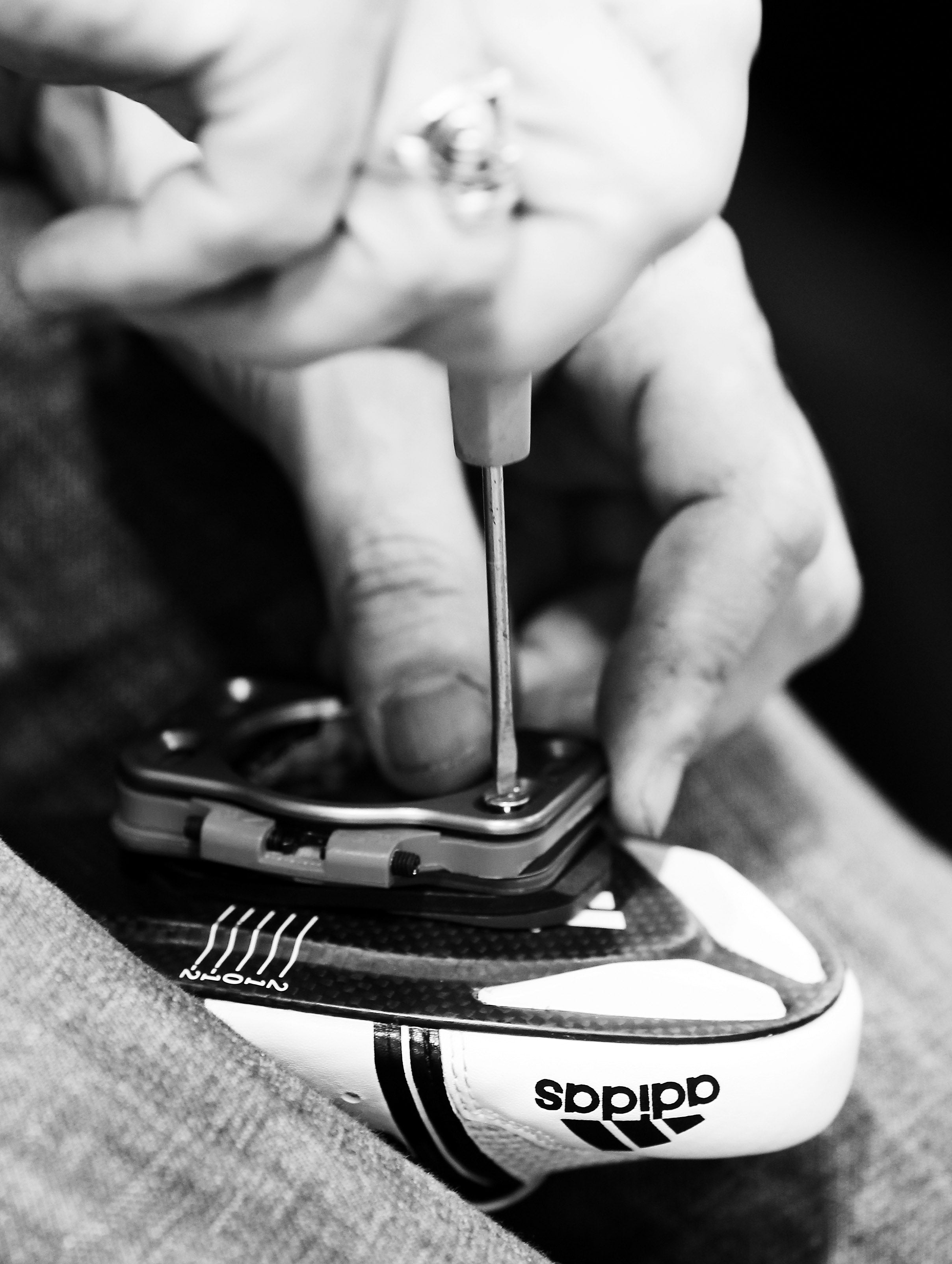
A pre-fitting assessment includes an analysis of any discomfort, numbness and pressure you may experience in your shoes. Allen then looks at where your cleats are currently placed. He also reads the marks left on the pedals, shoes and cranks to understand what biomechanical movements are happening while pedalling.
“The standard cleat position should ideally be in the centre of the ball of the foot,” says Allen. “And in most cases, the ball of the foot runs diagonally between the first and fifth metatarsal (big and small toes), so not horizontally.”
Read more: What is cycling economy and how do we improve it?
Through his experience in bike fitting, he says that the typical cleat position ends up being slightly behind the big toe and slightly in front of the small one. You may have noticed that, to make things easier, pedals usually come with a small mark indicating the centre of the pedal axle. Shoes also come with a whole range of measurements on their soles and they locate where the centre of the ball should be. If when you align the centre of the ball indicated on the shoes with the centre of the pedal axle, you're already in a good position. However, what works for most people may not work for all.
That's why looking at your pedalling technique, how your feet move during the pedal stroke, and even the wear and tear on cleats, shoes and pedals, may reveal your body's preferred way of pedalling.

"I can see this with well-used cleats or pedals," says Allen. "They have been wearing away in a way that suggests they've been fighting against the pedal float limitations. And obviously, this often results in some level of injury."
Reasons for cleat compensation
There could be several reasons why your body over-compensates your current cleat position. Allen explains it could be the angle of the cleats themselves, but it could also be a lack of or inadequate shoe support. That's why Allen works in a highly individualised way and approaches every foot (even the two feet of a single person) individually. "Symmetries in foot structure means that somebody can have one foot that turns slightly in and one that turns slightly out,” he explains.
Read more: Do I need custom insoles for cycling?
If the asymmetry is something that cannot be addressed through bike fit or physiotherapy, Allen works around that. “The position of the cleats is important, but I wouldn't necessarily set up each cleat identically. The only thing I generally try and keep identical is fore-aft position,” he says.

Ideal float
Finally, Allen says that most people prefer the four to five degree rotation in terms of floating angles. If people need more rotation, they can always go above that, but too much rotation isn't necessarily the solution either, because it can cause other coping mechanisms (your body moving in other directions to compensate for the excessive feet movements). On the other hand, no rotation at all – particularly for road cyclists, says Allen – isn’t recommended because it’d be impossible to find the exact angle of cleat placement your foot would prefer. Plus, on a long ride, not having some degree of rotation can cause greater muscle fatigue and even injury, especially if the cleats aren’t in the correct place.
As you can see, there's definitely more than meets the eye when we're talking about cleat positioning. A more neutral position in the centre of the ball of the feet may work as a starting point, but you should also pay attention to the wear and tear of your shoe and how your feet move. The position used by most people may work for you but it may not. If you can't solve the riddle on your own, investing in a good bike fit is always a great way to limit issues in the long run.
How to set and change your cycling cleats
- Before replacing your old cleats, look for signs and marks and wear and tear. Try to understand how your feet move during the pedal stroke.
-
Aim to place the cleats in the centre of the ball of the foot, which runs diagonally from the big and small toes.
- Pedals come with a small mark indicating the centre of the pedal axle, while shoes come with a range of measurements to locate the centre of the ball.
- Try to adapt the position at the centre of the ball with the natural position your feet tend to move to when you pedal.
- Do not necessarily place them in the same exact position, but try to adapt your left and right cleats to your left and right feet patterns.